1) Context
In the age of Artificial Intelligence (AI), learn everything you should know about the Governance Operations to manage your Data the right way.
2) Approach
Since the audience is not expected to have any prior knowledge, and because it will be a diverse audience (people with or without experience in data and IT), we adapted the course accordingly.
2.1) Solving Business Problems with Data
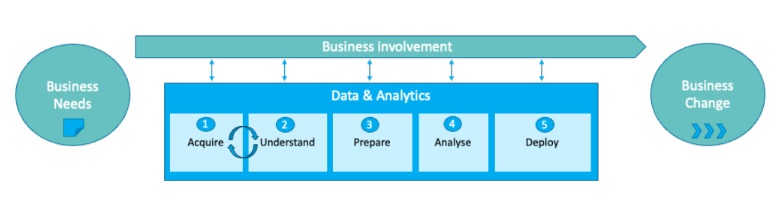
Solving Business Problems with Data is a proven course in which a recognizable business problem is explained and then solved in five steps using data.
2.2) Use-case–based approach
In addition to a recognizable use case, each participant is also asked to write down his or her own business problem and solve it step by step during the course.
After the introduction on the importance and value of data (we use, among other things, the data from the Titanic), we explain a portion of theory for each step, which is then immediately applied in practice.
This practical part consists of groups of participants receiving an assignment in which they experience the problems themselves. After the assignment, the solutions are discussed. During each exercise, every participant is also helped in applying each step to his or her own use case.
→ This approach ensures that participants learn by being confronted with the challenges, by thinking of solutions, and by applying those solutions to their own (business) problem.
In the fourth step, for example, we not only discuss traditional analysis and business intelligence, but we also cover the use of AI and LLMs.
Participants will also build their own machine learning model, which they can continue using at home and share with friends and family.
2.3) Data Governance
Data Governance and Data Quality* are mainly discussed in Step 2, but they form the common thread throughout the entire course. All steps depend on good Data Governance and Data Quality.
In this course, all aspects of Data Governance are covered through several exercises, real-life examples, and targeted questions.
This includes topics ranging from data ownership and stewardship, to business glossaries and data dictionaries, lineage (the origin of the data), change management, and working with color models, as well as all aspects of data quality (from discovery and profiling to defining business and technical data quality rules, and remediating data—such as cleanse, enrich, validate, match, and merge).
* Data Quality is considered part of data governance, just like metadata management, data modeling, etc.
Target Audience
- Business Executives
- IT Managers
- Project Managers
- Financial Risk and IT Risk Professionals
- Database Professionals
Max capacity
We can have no more than 20 participants.
Spots are available on a first-come, first-served basis.
CPE points:
8 pnt
Trainer
Christoph Balduck
As managing partner and CTO of Data Trust Associates, Christoph
Balduck supports organizations in the areas of privacy, data
protection, data compliance and information security. Christoph
combines these capabilities with expertise in data management –
especially focussed on Data and AI governance, Data Quality and Data Architecture.
His vision has always been that the world of data compliance is thightly coupled with the world
of data management and AI. With growing digital regulations in all parts of the world, we see
both of these worlds coming together. Most new digital regulations embed parts of data
management, data interoperability, privacy & data protection and information security.