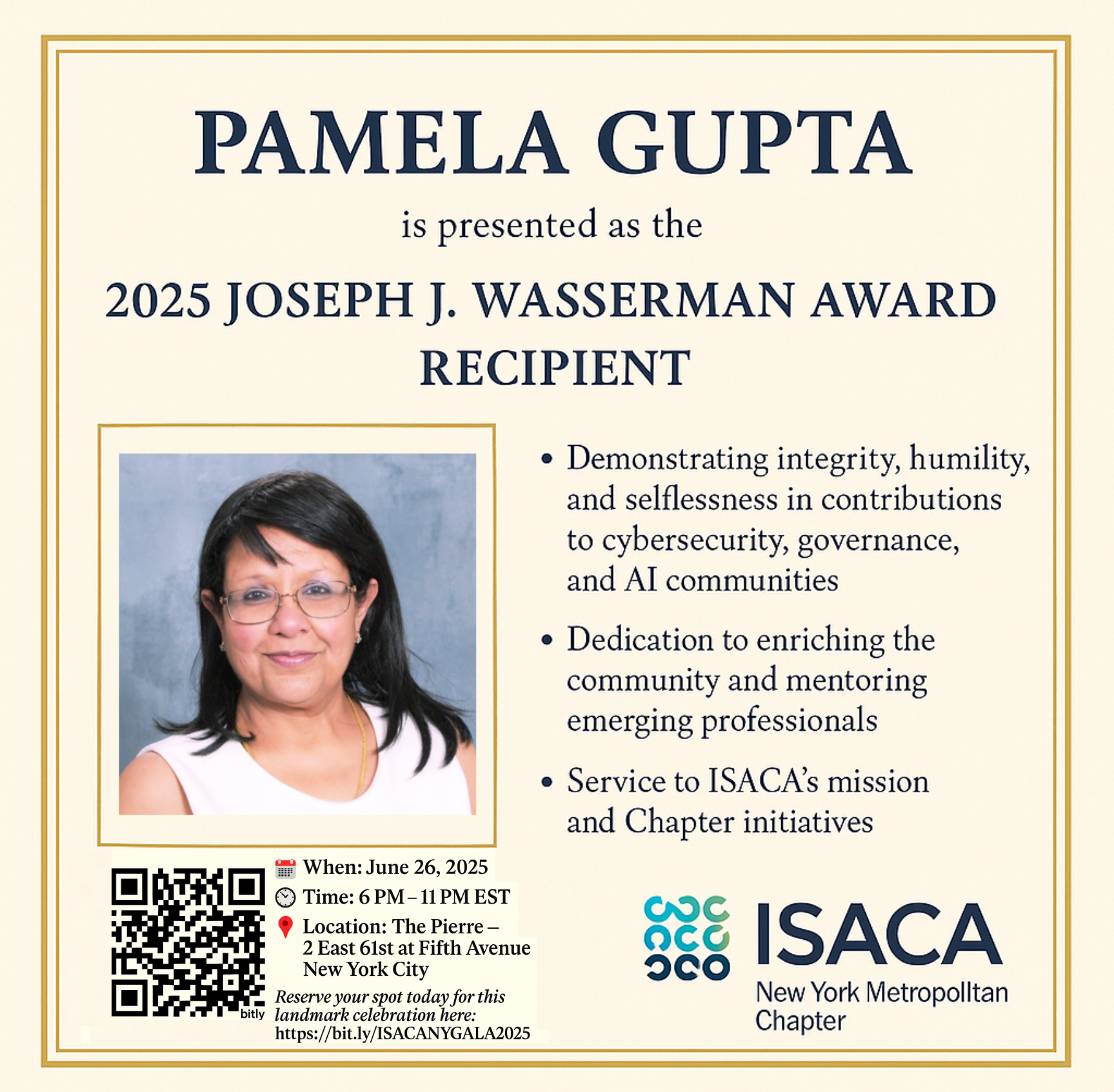
 Pamela Gupta is the CEO of Trusted AI, a company specializing in integrating security, privacy, and governance into artificial intelligence (AI) systems. With over 25 years of experience, she has become a leading global voice in cybersecurity, data strategy, and AI governance. Pamela has developed frameworks such as the 8 Essential Pillars of Trustworthy AI and AI TIPS (Artificial Intelligence Transparency, Integrity, Privacy, and Security) to operationalize governance in AI systems. She has been recognized among the Top 20 Global Risk Management and Top 50 Cybersecurity experts globally since 2020. Pamela is well known in our community for establishing the North East Annual Cybersecurity Summit (NEACS) which is unique in its focus on providing a business perspective on cybersecurity.
Pamela chairs global multi-stakeholder workgroups for IoT Security, Artificial Intelligence, and other emerging technologies. She co-chairs the NIST GCTC Smart Community Security & Privacy Council and chairs the IEEE AI Next Generation Working Group. Her insights have shaped strategies for efficient digital transformation and governance views on algorithmic failures.
As an advisor to startups and organizations, Pamela assists in harmonizing regulations to alleviate audit fatigue. She focuses on building security, privacy, and AI governance, ensuring compliance with evolving legal standards. Her work emphasizes the importance of securing AI to protect privacy, ensure integrity, and comply with legal standards.
Pamela is a thought leader on trustworthy AI, frequently speaking at global conferences and panels. She has hosted events highlighting areas of concern and risk around AI, aiming to move from dialogue to action. Her podcast, "Trustworthy AI: De-risk Business Adoption of AI," further demonstrates her commitment to educating and guiding the industry.
Pamela’s philanthropic contributions include:
· Mentorship and Advocacy: Pamela founded the Women in CyberSecurity (WiCyS) Trusted AI Affiliate, a group dedicated to advancing trust in AI by building secure and ethical AI systems.
· Educational Content: Pamela has authored articles and whitepapers on AI ethics and security, sharing her expertise with the broader community. For instance, she co-authored a whitepaper titled "Generative AI Policy: A Comprehensive Analysis and Recommendations for EU and US Local Governments," providing insights into AI policy development.
· Community & Industry Impact: Through her leadership at Trusted AI, Pamela collaborates with nonprofits to advance AI trust and inclusion. She mentors early-career professionals, advocating for ethical AI practices and uplifting marginalized voices in the AI community. Her holistic approach to tech governance has made her a pioneer in trusted AI.
We are thrilled to add Pamela to our list of Wasserman honorees!
Award Recipients
|
J. Wasserman Award Recipients
|
|
2025
|
Pamela Gupta
|
2009
|
Deepak Sarup
|
1993
|
Lily Shue
|
|
2024
|
Alexander Abramov
|
2008
|
Paul Williams
|
1992
|
Keagle Davis
|
|
2023
|
Chris Dimitriadis
|
2007
|
Marios Damianides
|
1991
|
John Lainhart
|
|
2022
|
Jim Ambrosini
|
2006
|
Eugene Spafford
|
1990
|
Martin King
|
|
2021
|
Brian Barnier
|
2005
|
Erik Guldentops
|
1989
|
William Murray
|
|
2020
|
Medha Bhalodkar
|
2004
|
S. Rao Vallabhaneni
|
1988
|
Steven Ross
|
|
2019
|
Phil Venables
|
2003
|
Peter Wild
|
1987
|
Michael Cangemi
|
|
2018
|
Theresa Grafenstine
|
2002
|
Gordon E. Smith
|
1986
|
Richard Guiltinan
|
|
2017
|
Robert Roussey
|
2001
|
Thomas A. Dietz
|
1985
|
Stanley Halper
|
|
2016
|
Ron Ross
|
2000
|
Emil G. D'Angelo
|
1984
|
Michael Sobol
|
|
2015
|
Charles Blauner
|
1999
|
Kathleen O'Hare
|
1983
|
William Perry
|
|
2014
|
George Hertzberg
|
1998
|
Belden Menkus
|
1982
|
Harold Weiss
|
|
2013
|
Robert Stroud
|
1997
|
Ira R. Weiss
|
1981
|
John Cullinane
|
|
2012
|
Everett Johnson
|
1996
|
Michael Donahue
|
1980
|
Jerry Fitzgerald
|
|
2011
|
Miklos Vasarhelyi
|
1995
|
Robert G. Parker
|
1979
|
Thomas Fitzgerald
|
|
2010
|
Robert A. Clyde
|
1994
|
Stanley Stash Jarocki
|
1978
|
Donald Adams
|
About Joseph J. Wasserman (1932 - 1978)

Joe Wasserman was born in New Haven, Connecticut on May 21, 1932, a depression-born Connecticut Yankee. Upon completion of US Navy active duty in 1956, Joe was employed as an internal auditor with the Southern New England Bell Telephone Company in New Haven. There he established the company's first IS Audit function and developed such concepts as the integrated test facility, the tagging of data and the use of audit software.
By 1965, Joe had advance to Audit Manager at AT&T's New York Headquarters, having responsibility for the audit of Bell Systems in the US and Canada. In 1967, Joe moved to AT&T's Bell labs as manager of Audit R&D. In 1969, together with Dick Hirschfield, he founded Computer Audit Systems, Inc. (CAS). They developed the Computer Audit Retrieval System (CARS) and produced seminars in computer auditing including applications of the CARS software. At the time, the only publicized computer audit software was Auditape available from Haskins and Sells. Both systems generated COBOL programs on IBM mainframes using punched card control parameters.
Joe had placed CARS in over 400 computer centers and his marketing had reached the boardrooms of the Fortune 1000 and the partners of the largest public accounting firms. His professional competence and energy earned him the respect and friendship of many. Joe continued in a consulting capacity, including serving as an expert in the Equity Funding case until his untimely death in 1978.
Steve Ross
ISACA NEW YORK METROPOLITAN CHAPTER President (1978-1979)
Wasserman Award Recipient – 1988